
When people hear the word blockchain, Bitcoin is usually the first thing that comes to mind. However, understanding the different types of blockchains and why they matter goes beyond Bitcoin alone.
That’s understandable. Bitcoin introduced blockchain technology to a huge audience, and it remains one of the best-known examples of a public blockchain.
But blockchain isn’t one fixed design. The different types of blockchains are designed to meet different needs, depending on who can participate, how transactions are validated, and how data is accessed.
A network can be open to everyone, restricted to a single company, shared by several organizations, or designed so that some information stays private while selected information can be verified publicly. There are also scaling systems, such as Layer 2 networks, that operate alongside a blockchain rather than fitting neatly into those four categories.
That difference is exactly why different types of blockchains matter.
A blockchain designed for a cryptocurrency has very different requirements from one used by a group of banks or a company managing internal records. When comparing blockchain types, the important questions are fairly simple: Who can join? Who can validate transactions? Who can see the data? And who gets to make the rules?
The four broad blockchain categories most commonly used when discussing network access and governance are:
- 1Public blockchain: Open participation with no central gatekeeper.
- 2Private blockchain: Access is controlled by one organization.
- 3Consortium blockchain: Several organizations share responsibility for the network.
- 4Hybrid blockchain: Private and public characteristics are combined, usually to keep sensitive information restricted while making selected information verifiable.
There is another distinction worth knowing. Blockchain networks can also be described as permissionless or permissioned. That classification focuses more specifically on whether authorization is required to perform certain network functions.
And then there are sidechains and Layer 2 networks. These are primarily scaling approaches, so they shouldn’t simply be added to the four categories as if they describe the same thing.
What Is a Blockchain, Exactly?
Forget the technical buzzwords for a moment.
At its simplest, a blockchain is a shared digital ledger. Instead of keeping the record in one place, copies of the ledger can be maintained by multiple computers participating in the network. Understanding the different types of blockchains and why they matter starts with knowing how these networks manage shared records and participation.
Transactions are collected into blocks. Each block is connected to the previous one using cryptographic techniques, creating a history that is difficult to alter without detection.
The network also needs a way to agree on which transactions are valid. That’s where a consensus mechanism comes in.
The basic idea remains similar across many blockchain systems. What changes from one network to another is the way participation is handled. These differences help explain why some blockchain types are open to everyone, while others restrict access to approved users or organizations.
- Who can read the ledger?
- Who can submit transactions?
- Who can validate them?
- Who controls upgrades?
- Who is responsible if something goes wrong?
These questions help explain the different types of blockchains and why they matter for security, transparency, privacy, and control. The answers can make one blockchain very different from another.
1. Public Blockchains
A public blockchain is the model most people associate with cryptocurrency. Understanding the different types of blockchains and why they matter starts with looking at how public networks allow people to participate without relying on a single controlling organization.
The network is generally open, meaning people don’t need permission from a particular company before interacting with it. Depending on the blockchain, participants may be able to run nodes, submit transactions, or help validate the network.
Bitcoin is the classic example. Ethereum is another major public blockchain, although its design and functionality are considerably broader than Bitcoin’s.
The appeal of a public network is straightforward: you don’t have to place the entire system in the hands of one company or institution.
When exploring Different Types of Blockchains and Why They Matter, public blockchains are a great place to start. These networks allow people from around the world to participate without seeking approval from a single organization, making them suitable for cryptocurrencies, decentralized applications, and systems that value openness and transparency.
Instead, the rules are enforced by the protocol and the participants following it.
Why Public Blockchains Are Useful
The biggest advantage is openness.
Someone in one country can interact with a public blockchain without first opening an account with the organization operating the network. That property is particularly important for decentralized financial systems and applications designed for global participation.
Public blockchains can also provide a high degree of transparency. On networks where transaction data is publicly available, anyone can independently inspect the ledger rather than relying solely on a company’s internal records.
This is one reason the different types of blockchains matter: public networks can support openness and independent verification, while other blockchain models may prioritize restricted access, privacy, or organizational control.
There’s a trade-off, though.
A system designed to operate without a central authority has to solve the difficult problem of getting many independent participants to agree on the state of the network. That can introduce costs, latency, and other limitations.
Advantages
- Open participation
- No single organization needs to approve every participant
- Publicly verifiable transaction history on transparent networks
- Strong resistance to unilateral censorship
- Suitable for decentralized applications and digital assets
Limitations
- Public transaction data can create privacy concerns
- Network fees can increase when demand is high
- Consensus can introduce performance constraints
- Different consensus mechanisms have different resource requirements
- Governance can be more complicated when control is distributed
Where Public Blockchains Make Sense
Public networks are a natural fit when open participation and reduced dependence on a central authority are more important than complete privacy or centralized control.
Typical examples include cryptocurrency networks, decentralized finance applications, tokenized assets, and smart-contract platforms.
2. Private Blockchains
A private blockchain takes almost the opposite approach to a public network. Understanding the different types of blockchains and why they matter means recognizing that not every network needs to be open to everyone.
Instead of opening the network to everyone, participation is restricted. A particular organization may decide who can join, who can validate transactions, and what information different participants are allowed to access.
That can make sense in a business environment.
Imagine a company maintaining a shared record between several departments. It may have no reason to let the general public participate in that network. What it actually needs is controlled access and a reliable record that authorized employees or systems can work with.
A private blockchain provides that kind of environment, making it useful for organizations that prioritize controlled participation, data access, and internal governance.
One important reason Different Types of Blockchains and Why They Matter is worth understanding is that not every organization needs an open network. Private blockchains offer controlled participation, allowing businesses to manage access, protect sensitive information, and establish rules that fit their internal operations.
The Main Advantage: Control
The organization running a private blockchain can define its rules. This is one of the key differences to consider when exploring the different types of blockchains and why they matter for businesses and other organizations.
It can determine who gets access, what roles participants have, and how transactions are validated.
Because the participants are known, the network doesn’t necessarily need the same type of open participation mechanism used by a public blockchain. That can make certain private systems faster and easier to manage.
But there’s an obvious compromise.
If one organization controls the network, users ultimately have to trust that organization to manage access and follow the established rules.
That’s quite different from Bitcoin, where the system isn’t dependent on one company maintaining the entire network.
Advantages
- Controlled access
- Greater privacy for internal information
- Predictable governance
- Permissions can be customized
- Potentially higher performance in controlled environments
Limitations
- Greater reliance on the organization operating the network
- Less decentralized than an open public blockchain
- Insider control becomes a more important consideration
- Limited public transparency
- In some cases, a conventional database may solve the problem more simply
That last point is worth remembering.
Putting a database behind a blockchain label doesn’t automatically make the system better. If the participants already trust one organization and don’t need shared governance, a traditional database might be the more practical choice.
Common Uses
Private blockchain systems can be considered for enterprise records, internal workflows, controlled data sharing, auditing, and other situations where participants are already known.
Hyperledger Fabric is one example of technology designed for permissioned blockchain networks.
3. Consortium Blockchains
Now imagine a situation where a private blockchain controlled by one company isn’t enough.
Suppose five independent companies need to maintain a shared record. None of them wants to hand complete control to one of the other four.
That’s where the consortium model becomes interesting. When exploring the different types of blockchains and why they matter, consortium networks show how multiple organizations can share responsibility without giving control to a single company.
A consortium blockchain is governed by a group of organizations. Rather than one company making all the decisions, participating members share responsibility for the network.
This model is especially relevant when organizations compete in the marketplace but still need to cooperate on certain processes.
Think of supply chains.
A manufacturer, shipping company, customs provider, warehouse operator, and retailer may all need access to information about the same shipment. They have different business interests, but they still need a reliable shared record.
The concept of Different Types of Blockchains and Why They Matter becomes especially clear when multiple organizations need to work together. Consortium blockchains allow selected members to share responsibility for maintaining a network, making this model useful for supply chains, trade finance, and shared industry records where no single participant should have complete control.
A consortium model can provide that shared environment without requiring one participant to become the sole administrator.
What Makes Consortium Networks Different?
The key difference is governance.
With a private blockchain, one organization typically has primary control.
With a consortium blockchain, authority is distributed among a defined group. This distinction helps explain why different blockchain models suit different organizational needs.
That doesn’t mean every consortium gives every member exactly the same power. The governance rules depend on the implementation. Some participants may have different permissions or responsibilities.
Advantages
- Shared control between participating organizations
- Restricted access
- Better suited to multi-company collaboration
- Potentially faster than an open public network
- Sensitive information can remain within the participating group
Challenges
The difficult part is often not the technology.
It’s the people.
Several independent organizations have to agree on rules, upgrades, access policies, responsibilities, and dispute procedures. If those organizations have conflicting interests, governance can become complicated very quickly.
There’s also a security consideration. A consortium isn’t magically trustworthy just because several companies are involved. The security of the network still depends on its architecture and the organizations responsible for maintaining it.
Where Consortium Blockchains Can Fit
- Supply-chain coordination
- Trade finance
- Interbank systems
- Shared industry records
- Cross-company verification
The model is particularly useful when several organizations need one trusted record but don’t want one organization to own the whole system.
4. Hybrid Blockchains
Hybrid blockchains attempt to combine two things that normally pull in different directions: privacy and public verifiability. Understanding the different types of blockchains and why they matter helps explain how hybrid networks balance these two requirements.
The exact design can vary, but the basic idea is easy to understand.
Sensitive operational information remains restricted. At the same time, selected information—or a cryptographic proof that something happened—can be made available for outside verification.
That can be useful when an organization needs to prove something without exposing everything behind the proof.
For example, a company might want to demonstrate that a particular record existed at a certain time without publishing the confidential contents of that record.
The public doesn’t necessarily need to see the entire database. It may only need enough information to verify the relevant claim.
Why Use a Hybrid Model?
Consider a supply-chain company.
Its internal systems may contain contracts, supplier pricing, customer information, and other commercially sensitive material. Publishing all of that data would obviously be a bad idea.
But the company may still want customers or auditors to verify the history of a particular product.
A hybrid design can potentially separate those two requirements. This is another reason the different types of blockchains and why they matter deserve attention: hybrid networks can offer controlled access to sensitive information while still supporting selected forms of public verification.
Advantages
- Sensitive information can remain restricted
- Selected information can be independently verified
- Access policies can be more flexible
- Can suit organizations that need both confidentiality and transparency
Limitations
- Architecture can be more complicated
- Governance remains important
- The operator still decides what information becomes public
- Integration with existing systems can require additional work
Hybrid blockchain shouldn’t be treated as a magic solution for privacy. The actual privacy level depends on the system’s architecture, permissions, cryptography, and operational practices.
Public vs. Private vs. Consortium vs. Hybrid
| Feature | Public | Private | Consortium | Hybrid |
|---|---|---|---|---|
| Participation | Generally open | Restricted | Restricted | Mixed |
| Governance | Distributed according to protocol | Mainly one organization | Shared by participating organizations | Depends on design |
| Transparency | Usually high | Usually limited | Limited to participants | Selective |
| Privacy | Generally lower | Higher | Higher | Configurable |
| Control | Distributed | Centralized | Shared | Mixed |
| Typical use | Cryptocurrency, DeFi, open applications | Internal enterprise systems | Multi-company networks | Selective transparency and verification |
There is an important caveat here: these labels are descriptive categories rather than a universal technical standard.
Real blockchain systems can blur the boundaries. A network may use permissioned validators while publishing selected proofs to a public chain, for example.
So it’s better to understand the underlying design than memorize four labels.
Permissioned vs. Permissionless Blockchains
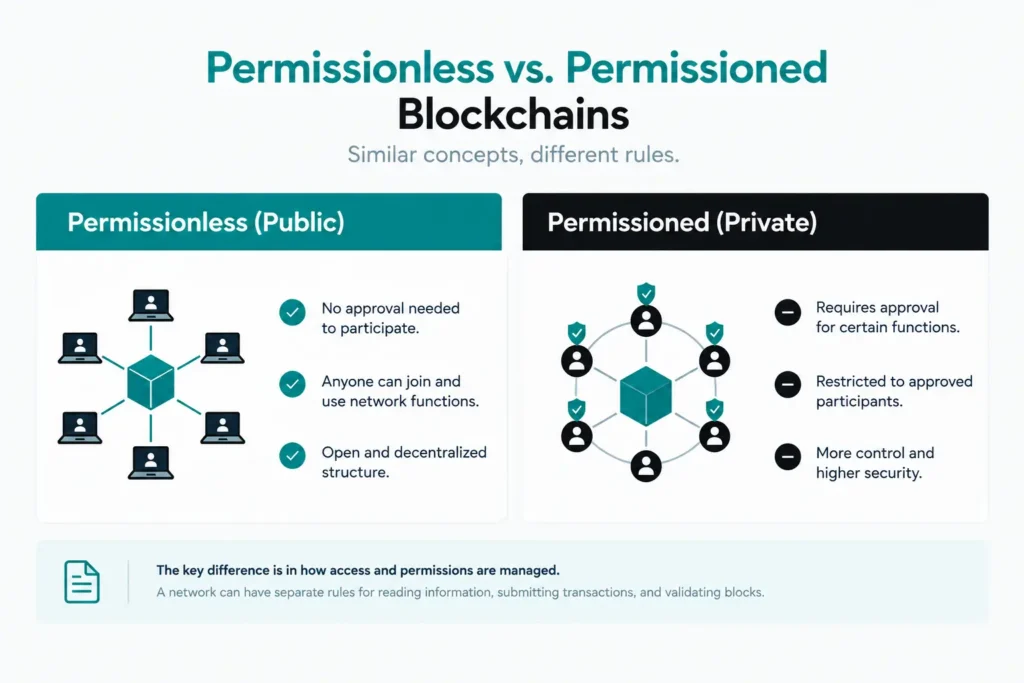
This distinction causes a surprising amount of confusion when exploring the different types of blockchains and why they matter.
People sometimes use public and permissionless as if they mean exactly the same thing. Likewise, private and permissioned are often treated as identical.
They’re closely related, but the terms describe different ideas.
A permissionless blockchain generally doesn’t require approval to participate in the relevant network functions.
A permissioned blockchain restricts certain functions to approved participants.
NIST uses this distinction when discussing blockchain systems and notes that permissionless networks allow participants to publish blocks without needing authorization, while permissioned systems restrict that ability.
The distinction becomes useful when looking beyond simple public/private labels.
A network can have separate rules for reading information, submitting transactions, and validating blocks. Those permissions don’t necessarily have to be identical.
Sidechains and Layer 2 Networks Are Different
Here’s another area where blockchain terminology gets messy. Understanding the different types of blockchains and why they matter also means recognizing that not every blockchain-related system belongs to the same category.
Sidechains and Layer 2 networks are often listed alongside the four main blockchain types. Technically, that’s not a very clean comparison.
The first four categories mainly describe access and governance.
Sidechains and Layer 2 systems are primarily concerned with scaling and extending blockchain functionality.
A sidechain is an independent blockchain that operates alongside another chain. It has its own security model and its own validator or consensus arrangements.
A Layer 2 network works differently.
It is built on top of a base blockchain and is designed to process transactions more efficiently while ultimately relying on the underlying chain in a particular way for settlement or security.
Ethereum’s ecosystem includes several Layer 2 approaches, including optimistic and zero-knowledge rollups.
So don’t think of Layer 2 as simply the “fifth type” of blockchain. The different types of blockchains and why they matter are better understood by separating access and governance models from technologies designed to improve scalability.
Sidechain vs. Layer 2 at a Glance
| Feature | Sidechain | Layer 2 |
|---|---|---|
| Main purpose | Extend functionality or capacity | Scale a base blockchain |
| Independent network | Yes | Usually built around a base chain |
| Own security model | Yes | Depends on the L2 design |
| Relationship with base chain | Connected to it | Designed to work on top of it |
| Example concept | Independent chain connected to another network | Rollup settling activity to a base chain |
This distinction matters because marketing descriptions can sometimes make different architectures sound almost identical.
They aren’t.
Different Types of Blockchains and Why They Matter
There’s no single blockchain design that maximizes everything at once. Understanding the different types of blockchains and why they matter helps explain why every architecture involves certain trade-offs.
If you want completely open participation, you give up some of the control available in a private environment.
If you want strict confidentiality, you usually can’t also make every record publicly visible.
If you want several competing companies to share control, governance becomes more involved than it would be inside one company.
In other words, blockchain architecture is largely about trade-offs.
Consider a few simple examples.
A cryptocurrency designed for strangers around the world needs a very different trust model from an internal company ledger.
A group of competing shipping companies may need shared governance.
A business dealing with confidential information may want controlled access but still need to prove certain facts to customers or regulators.
And an application struggling with transaction costs may not need a completely new blockchain at all. A Layer 2 solution could be a better fit.
The technology should follow the problem—not the other way around.
Where Are Different Blockchain Types Used?
The answer depends heavily on the network’s requirements. The different types of blockchains and why they matter become clearer when you look at their practical applications.
Public
Public blockchains are commonly associated with cryptocurrencies, decentralized finance, digital assets, smart contracts, and open applications.
Their strength is broad participation.
Private
Private networks are more relevant to controlled environments where an organization knows the participants and needs to manage access.
Enterprise record systems are a common example.
Consortium
Consortium networks become attractive when multiple organizations need to coordinate around shared data.
Supply chains and financial networks are examples of areas where this model can make sense.
Hybrid
Hybrid approaches can be useful when confidentiality and external verification are both important.
For example, an organization may want to keep its internal records private while allowing selected facts to be independently verified.
Layer 2
Layer 2 networks are primarily about improving the capacity or economics of a base blockchain.
They can be useful for applications that need more transaction throughput without moving completely away from the underlying network.
Which Type of Blockchain Is Best?
There isn’t one correct answer.
That’s probably the most useful thing to understand before choosing a blockchain architecture.
Ask what the system actually needs.
If anyone should be able to participate, a public blockchain may be appropriate.
If one organization needs strict control over access, a private system may make more sense.
If several independent organizations need to share responsibility, consider a consortium design.
If some information must remain private while other information needs to be publicly verifiable, a hybrid approach may be worth exploring.
And if the real problem is transaction capacity on an existing public chain, a Layer 2 solution may be the better choice. Ultimately, understanding the different types of blockchains and why they matter helps you select an architecture that fits your project’s specific needs., the answer
Don’t choose a blockchain because the word “blockchain” sounds more advanced than a database. Start with the trust problem. If the participants already trust one organization and don’t need shared control, a conventional database may be simpler, cheaper, and easier to maintain.
Frequently Asked Questions
01 What are the four main types of blockchains?
The four commonly discussed categories are public, private, consortium, and hybrid blockchains. They mainly differ in participation, governance, access control, and transparency.
02 Is Bitcoin a public or private blockchain?
Bitcoin is a public, permissionless blockchain. People can interact with the network without obtaining approval from a central organization.
03 Is Ethereum a public blockchain?
Yes. Ethereum Mainnet is a public, permissionless blockchain. It supports transactions as well as programmable applications through smart contracts.
04 What is a private blockchain used for?
Private blockchains can be used where access needs to be restricted to known participants. Examples can include internal enterprise records, controlled data-sharing systems, and certain regulated workflows.
05 What is the difference between a consortium and a private blockchain?
The biggest difference is governance.
A private blockchain is generally controlled by one organization. A consortium blockchain is operated or governed by multiple participating organizations.
06 What is a hybrid blockchain?
A hybrid blockchain combines private and public characteristics. A common approach is to keep sensitive information restricted while making selected information or proofs available for public verification.
07 Are Layer 2 networks a type of blockchain?
Layer 2 networks are better understood as scaling systems built around a base blockchain rather than as one of the four traditional governance categories. Their purpose is generally to process activity more efficiently while interacting with an underlying blockchain.
08 Which blockchain type is the most secure?
There is no universal answer.
Security depends on what threat you’re concerned about, how the network is designed, who controls it, how consensus works, how keys are managed, and how participants behave.
A public network may offer strong resistance to censorship or unilateral control, while a permissioned network may provide tighter access controls. Those are different security properties.
09 Can one blockchain belong to more than one category?
Yes.
The four labels are useful ways to describe blockchain architectures, but real systems can combine characteristics. For example, a permissioned network could publish selected proofs to a public blockchain.
Final Thoughts
Blockchain technology isn’t a single template that every project has to follow. Understanding the different types of blockchains and why they matter helps explain why different projects require different network designs.
Public networks prioritize open participation. Private networks put more emphasis on control and restricted access. Consortium blockchains are built around cooperation between multiple organizations, while hybrid approaches try to balance private information with selective public verification.
Then there are Layer 2 networks and sidechains, which address a different question: How can an existing blockchain handle more activity or provide additional functionality?
That’s why asking “Which blockchain is best?” isn’t particularly useful on its own.
A better question is: What does the system need to accomplish, and who needs to trust whom?
Once those requirements are clear, choosing between public, private, consortium, hybrid, or a scaling architecture becomes much easier. Ultimately, understanding the different types of blockchains and why they matter helps you choose a solution that fits the project’s actual needs.
The label comes second.
The problem comes first.
Recommended External References
nist.gov · Official NIST publication
ethereum.org · Official Ethereum developer documentation
hyperledger-fabric.readthedocs.io · Official Fabric documentation